Wedding seating guide
How to Seat Divorced Parents at a Wedding
If you are deciding how to seat divorced parents at a wedding, start with one question: would they both feel comfortable sharing a table with their current partners present? If the answer is no—or you are unsure—plan separate tables with familiar people and comparable views of the celebration. You do not need to make dinner a test of whether everyone can get along.
This guide covers the reception first, then the ceremony. It includes a fictional two-table example you can adapt, a way to discuss the plan without inviting a family vote, and a final checklist for your venue. The aim is a workable arrangement that you can stop worrying about once the wedding starts.
How to seat divorced parents at a wedding reception
There is no single arrangement that suits every divorced family. Choose the layout from the relationships you have today, including stepparents and current partners, rather than from a picture of how a parents' table is supposed to look.
The Knot's reception guidance describes equivalent but separate tables as an option when divorced parents have a difficult relationship. It also recognizes that parents may each host a table with their own relatives and friends. That gives you a useful starting point, without turning a seating convention into a rule everyone must follow. Read The Knot's parent-table guidance.
| Your situation | A practical starting point | What to confirm |
|---|---|---|
| Both parents and their partners actively want to sit together | One shared family table | Everyone agrees privately and the table has enough places |
| Parents can be civil but would enjoy dinner separately | Two comparable parent tables | Each has familiar company, a useful view and suitable access |
| Contact is uncomfortable or unwelcome | Separate tables with a reviewed room layout | Tables, walking routes and coordination arrangements |
| Both partners have divorced parents | Several smaller family groups | Household preferences, table capacity and who knows whom |
Option 1: One shared family table
A shared table can work when everyone genuinely prefers it. Ask each parent separately and include their partners in the decision. A polite “whatever you want” is not quite the same as wanting to spend dinner across from an ex-partner.
Count the whole group before committing. Two parents, two partners, grandparents and siblings can quickly outgrow the proposed table. Avoid solving that problem by moving one partner elsewhere while keeping everyone else together. If the group does not fit comfortably, two tables may be the simpler choice.
Option 2: Two separate parent tables
Give each parent people they would naturally talk to: their partner, siblings, relatives or close friends. Do not divide every family relationship into equal halves just to make the guest counts match. A sibling may prefer to sit with cousins, and a grandparent may need a quieter location.
Comparable treatment is more useful than exact symmetry. Check whether both tables can see the couple, hear speeches and reach the important parts of the venue. Two tables can be the same distance from your table while one has a pillar in the way or sits beside a loudspeaker.
Option 3: Separate tables with more space between them
Different table numbers do not necessarily create distance. Two round tables can be almost touching, and guests at opposite sides of the room may still meet every time they approach the bar. Review the floor plan, not just the guest list.
A dance floor between the parent tables can be one layout option, if it suits the room. It is not a reliable barrier: people will cross it, furniture may move, and dinner service needs clear routes. Ask the venue to check sightlines, accessibility and circulation before treating a sketch as the final plan.
Decide where you and your partner will sit
A sweetheart table lets the two of you sit together while each parent joins their own group. This can simplify a family arrangement where including one parent at the head table would create pressure to include several others. It is an option, not an obligation or a cure for every disagreement.
A wedding-party head table is another choice. Before choosing it, decide where the attendants' partners will sit and check the table's capacity. If you prefer a family head table, work out exactly who it includes before assigning the other tables; otherwise you may keep reopening the same decisions.
For more detail, see who sits at the head table. Make this decision early enough that neither parent discovers their arrangement by comparing it with the other parent's on the day.
A two-table example you can adapt
Here is a fictional starting point for a small family group. Alex and Sam, the couple, have a separate sweetheart table. “Mum” and “Dad” refer to Alex's parents; Jo and Pat are their respective partners. Replace these labels with guest names before sharing a real plan.
| Table | Guests | Planning note |
|---|---|---|
| Maple | Mum, Jo, Rose, Kim | Mum sits with her partner and two familiar guests |
| Willow | Dad, Pat, Leo, Robin | Dad sits with his partner and two familiar guests |
Place Maple and Willow where both groups have a reasonable view. They could sit on either side of the room, with the dance floor between them, if the venue layout supports that. They do not need to be mirror images. Check actual table sizes and chair clearance with the venue; this example assigns people, not certified room dimensions.
Notice what the plan does not do. It does not label a table “divorced parents,” identify a person as a problem, or ask Rose and Leo to act as mediators. The public seating chart only needs each guest's name and table assignment. Keep private coordination notes in a separate document.
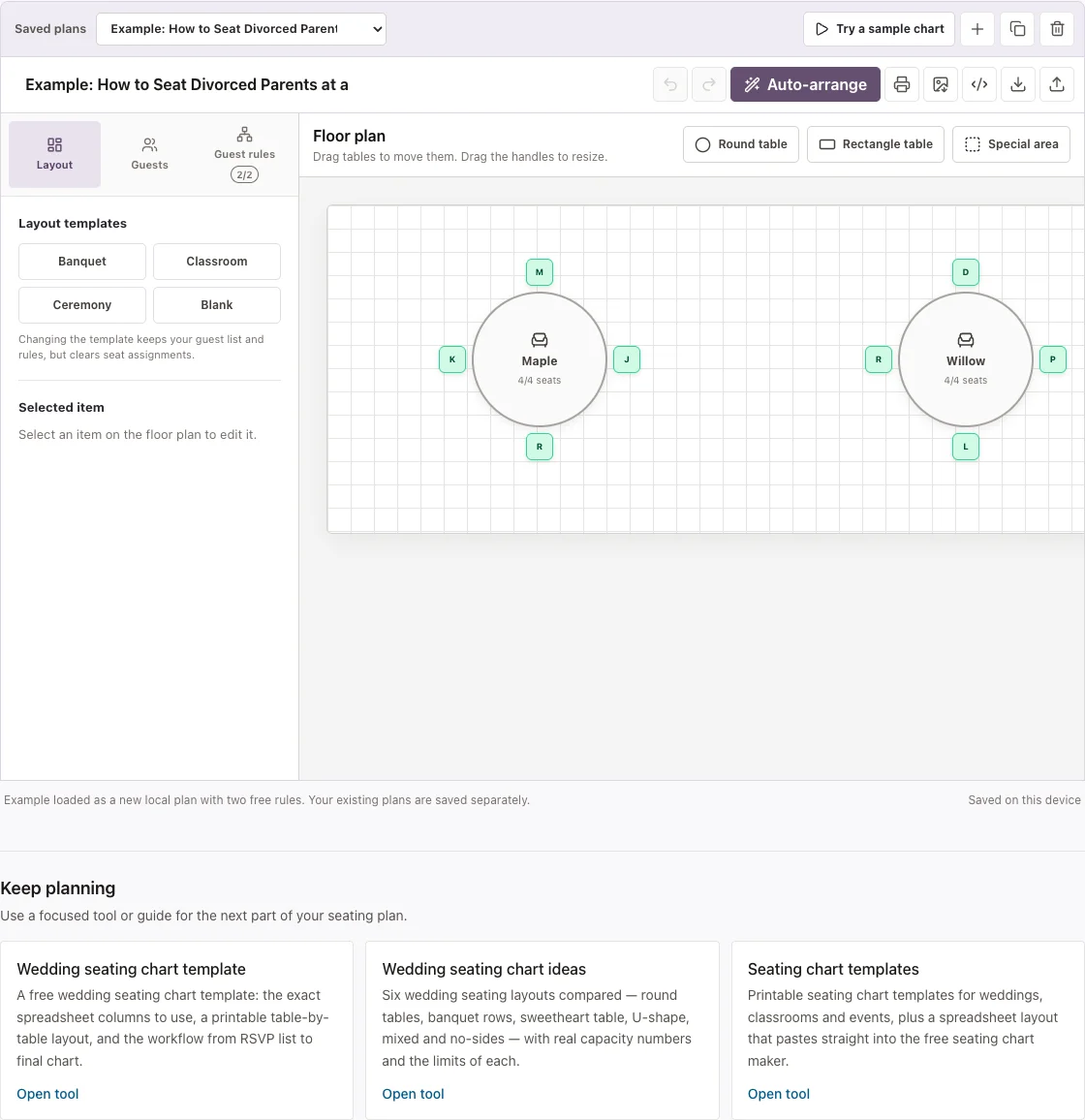
Actual tool screenshot with fictional guests. Table placement is illustrative, not a venue-approved floor plan.
Open this editable two-table example
Ask about preferences without outsourcing the whole chart
Speak to each parent privately before the layout is final. Ask a small, answerable question: “Would you be more comfortable having dinner at a separate table with Jo and your friends?” Follow up about practical needs, such as hearing speeches, avoiding stairs or sitting with a particular relative.
You can then explain the proposed arrangement in similar terms to each parent:
“We are giving each of you a table with people you know. Both tables will have a view of us. We are checking the positions with the venue, and I will send you your table assignment before the wedding.”
That is a suggested script, not a promise that both tables will be identical. Give a date for any essential corrections, then make the final decision with your partner. Repeatedly circulating the full chart can turn every small adjustment into another round of negotiation.
If someone requests a change, clarify what they need before moving people. “I cannot hear from that corner” needs a different response from “I want the lower table number.” Table names can remove one source of comparison, but they cannot resolve the underlying relationship for you.
Plan ceremony seating separately
Reception tables and ceremony rows are different decisions. Parents who prefer separate dinner tables may be happy in the same ceremony row; parents who can share dinner may still want separate ceremony entrances or seats. Do not assume that agreement about one covers the other.
Emily Post advises planning divorced-parent ceremony seating carefully and giving ushers clear instructions. Its guidance includes traditional arrangements, but your ceremony may use different family, cultural or religious conventions. Confirm the final row assignments with the officiant or ceremony coordinator. Read Emily Post's ceremony seating guidance.
Make a short reserved-seat list that includes current partners and anyone with access needs. Tell the ushers which entrance and row to use so they do not have to ask an awkward question in front of arriving guests. If there are no designated family sides, reserved seats can still make the arrangement clear.
Keep photo groups and entrances on the coordinator's schedule as separate items. A reception chart does not tell the photographer whether two people are comfortable standing together, and it should not be expected to.
Build the arrangement with two relationship rules
You can use the wedding seating chart maker to keep the important table assignments in view while arranging the rest of the room. Start with the fictional example or enter your own guest names and tables.
- Add the people and tables. Check spelling and table capacity before placing everyone. Use real guest names in the finished chart, rather than relationship labels.
- Add an Apart rule for the parents. In this example, Mum + Dad means they must be assigned to different tables when auto-arranging.
- Add a Together rule for one pair. Mum + Jo keeps that pair at the same table. These two pair rules use the free allowance.
- Review the other partner assignment. Dad and Pat start together in the example, but they do not have a Together rule protecting that pairing during a later auto-arrange. Check them again after each run and adjust manually if needed.
- Review the room, then export. Drag tables into the intended positions, inspect the guest assignments and prepare the print or PDF version for your venue.
The rule boundaries matter: Apart means different tables, not a minimum distance; Together means the same table, not adjacent chairs. The tool does not interpret family relationships, guarantee an unobstructed view or decide whether a dance floor creates enough separation.
Free plans allow two Together/Apart rules in total. If you want Dad + Pat protected automatically as a third rule, a paid Event Pass unlocks unlimited rules for that event. You can also stay with the free plan and review unprotected assignments manually. See the current price and pass terms.
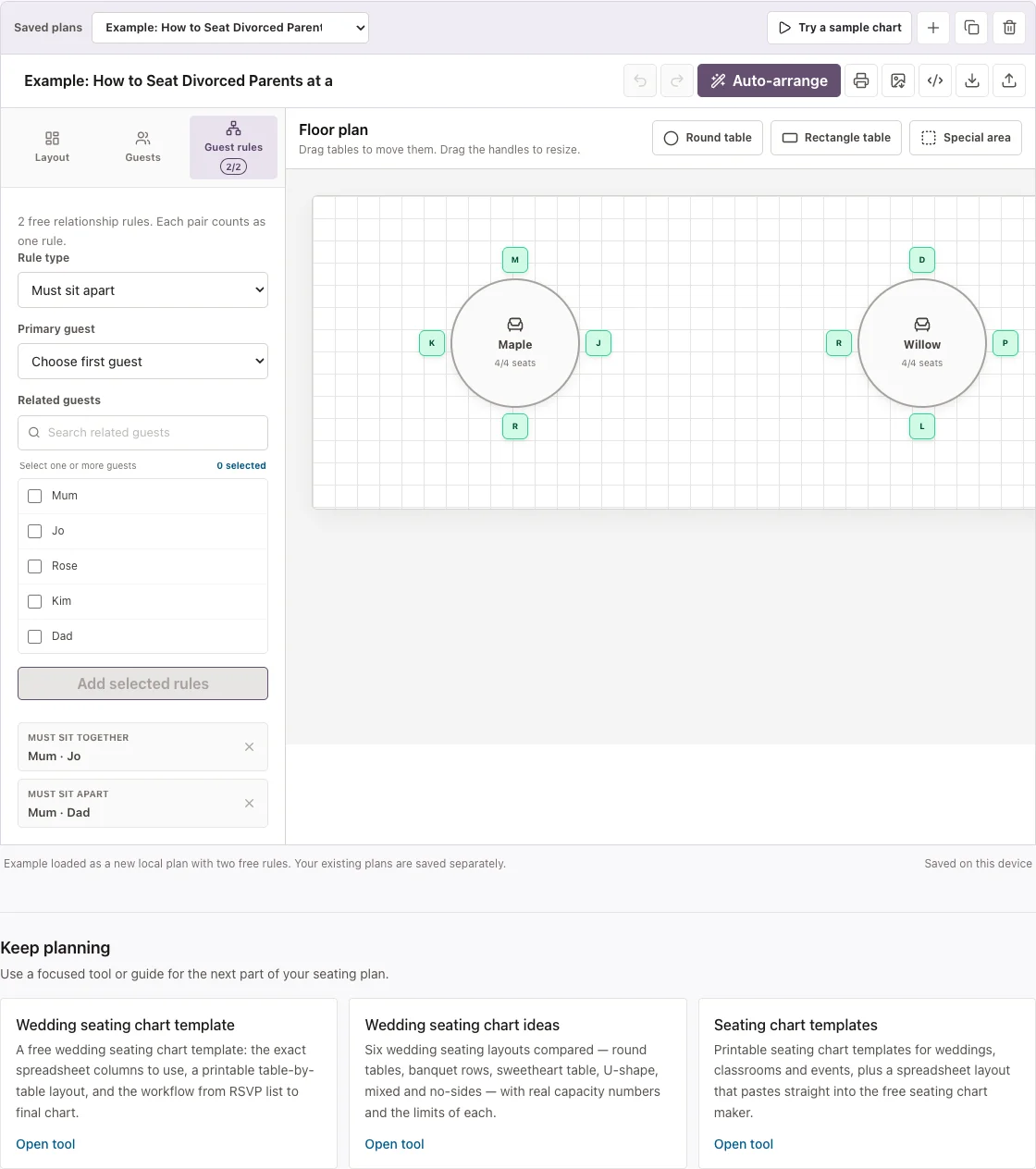
Actual tool screenshot: the two-rule example. Review unprotected pairings after auto-arrange.
Check the plan before sharing it
Review the finished arrangement with your partner and the venue contact. Use this checklist for the final version:
- Both parents know their table assignment before the day.
- Partners and familiar companions have been included deliberately.
- Every table fits its assigned guests using the venue's confirmed capacity.
- Views, hearing needs and access routes have been checked in the actual room.
- Ceremony seats and reception tables are documented separately.
- The guest-facing chart contains names and table assignments, without private explanations.
- One trusted coordinator knows how to handle last-minute seating questions.
- The venue and coordinator have the same dated final version.
If one guest cancels, review the people affected before running the entire plan again. A small manual change may be enough. If you do auto-arrange again, recheck all the relationships you have not protected with rules, then export a fresh copy so nobody works from the previous chart.
Related wedding seating guides
- Wedding seating for blended families: work through partners, siblings and several family groups.
- Who sits at the head table?: compare the couple's table with a wedding-party or family arrangement.
Frequently Asked Questions
Do divorced parents have to sit together at a wedding?
No. Separate tables are a practical option when either parent would be uncomfortable sharing dinner. A shared table can also work when both parents and their current partners are comfortable with it; ask rather than assume.
Where should stepparents sit at the reception?
A useful starting point is to seat a parent with their current partner and familiar guests. Check the wishes and needs of the people involved instead of treating a stepparent as an extra seat to fit in later. If the household arrangement is complicated, discuss it privately before publishing the chart.
What if both sets of parents are divorced?
Plan each household or comfortable family group separately; you do not need one table for all parents. Use as many appropriate tables as the guest list and venue require, giving each group a considered position. A sweetheart table may simplify where the couple sits while those groups take shape.
Can I put divorced parents on opposite sides of the dance floor?
Yes, if that arrangement works with your venue's layout and their needs. Check the views, speakers and walking routes, because a dance floor is not a physical barrier. Different-table rules alone do not create or maintain that spacing.
Does a Together rule put two guests next to each other?
In EasySeatingChart, Together means the same table, not adjacent chairs. Apart means different tables, not a set distance between them. Review the final arrangement and coordinate any exact chair positions with your venue.