A LITTLE PLANNING
Make room for a good day.
A wedding seating planner that keeps guests together or apart
EasySeatingChart is for couples who want an editable reception layout and help arranging guests around relationships. Create tables, add guests and arrange seats manually for free. Free auto-arrange and Print / Save PDF are included; no account is required for local planning.
With a $9.90 Event Pass for one wedding, add Together rules for couples or family groups and Apart rules for people who should not share a table. Together means the same table, not adjacent chairs. Apart means different tables, not a guaranteed physical distance. Review the result and position tables yourself to suit the venue.
How to arrange wedding guests around relationships
- Add your guest list and tables. Confirm usable table capacity with your venue before assigning seats.
- Choose your approach: place guests manually for free, or activate an Event Pass to configure Together/Apart rules before auto-arranging.
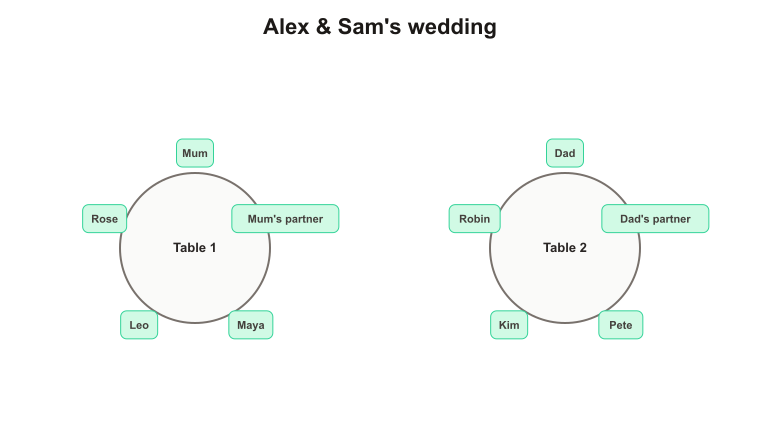
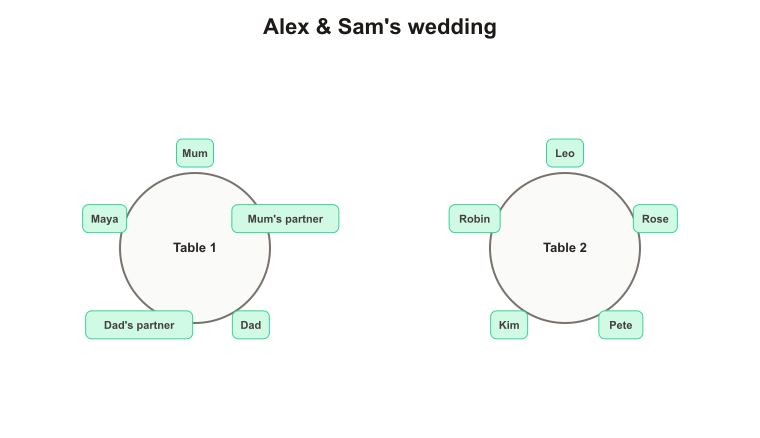
- For divorced parents who need separate tables, add an Apart rule. Add Together rules for any attending partners whose pairings should be preserved. These relationship rules require the pass.
- Run auto-arrange, review unseated guests and conflicts, then check the exact chairs and table locations. Print or save a PDF when the plan is ready.
Divorced parents: the case that breaks most charts
When divorced parents prefer separate tables, start with the people each would feel comfortable eating with. Include current partners and discuss preferences privately; a shared parents' table is not required.
The practical approach that most planners settle on is to give each parent their own table where they host their own side of the family, rather than trying to combine them into one parents' table. What matters just as much is that neither table looks demoted. If one parent is placed beside the head table and the other is three rows back, that difference will be noticed and remembered, whatever you intended by it. When you lay out your tables, keep the two parent tables roughly the same distance from the top table, and try to give them comparable neighbours.
If a new partner is attending, seat them with the parent they came with. Splitting them up to avoid awkwardness usually creates more of it, not less. And if two parents are genuinely not on speaking terms, use an Apart rule with an Event Pass, or keep their manual assignments under review as you edit the free plan.
How many tables will you need
- A 60-inch round table is normally set for eight, and can take ten if the place settings are tight. Ten is fine for a younger crowd and cramped for a formal dinner.
- Long banquet tables usually take ten to twelve, but people at the far ends effectively only talk to four others, so they suit family groups better than mixed tables.
- Leave one table's worth of slack. Late acceptances, a plus-one you forgot about and a supplier who needs feeding all turn up eventually.
- The capacity counter under the table settings compares your seats against your list size, so you will see a shortfall immediately rather than when you print.
When auto-arrange cannot seat someone
If a guest is left in the unseated area, the planner could not find a complete placement without knowingly breaking a hard rule. Check total capacity, individual table sizes, locked seats and contradictory rules. You can add a table, add a seat, unlock a fixed placement or turn a cautious must-not into a preference.
Printing and place cards
Click Print / Save PDF and choose 'Save as PDF' in your browser's print dialog. The printed sheet drops every button and control and gives you a clean table-by-table list with your event name at the top — the format your venue and caterer will ask for. Print one copy for the venue, one for whoever is directing guests on the day, and keep the PDF on your phone. If you would rather start on paper, there are printable seating chart templates; for classes and workshops use the classroom seating chart maker.
Put the finished plan on your wedding website
Choose Embed plan to add a clean, read-only seating chart to your wedding website or guest-information page. You decide whether guest names appear; planning notes, meal choices, accessibility information and relationship rules stay out of the published copy.
The embed is a snapshot rather than a live link to your working plan. You can continue rearranging privately, then replace the embed code only when you are ready to publish the next version.