Wedding seating guide
Wedding Seating Chart Etiquette: Who Sits Where
Wedding seating chart etiquette starts with making guests comfortable: seat invited partners together, give each person someone to talk to, and check access, views and table capacity before worrying about tradition. The couple can choose a sweetheart table, a wedding-party table or a family table. Parents do not all have to share one table, and unpartnered guests do not need a separate “singles table.”
This guide focuses on the reception. Ceremony rows, processional positions and religious customs need their own plan with your officiant or coordinator. The suggestions below are practical starting points, not universal rules for every culture or family. Use them to make decisions, then check the details with the people and venue involved.
Wedding seating chart etiquette at a glance
Begin with the guest's experience of dinner. Can they reach their place comfortably? Will they recognize someone at the table? Are they separated from the person they came with? A beautiful floor plan is not finished until those questions have answers.
| Guest or group | A considerate starting point | Check before finalizing |
|---|---|---|
| The couple | Sweetheart, wedding-party or family table | Which arrangement you actually want for dinner |
| Parents and stepparents | Together if comfortable, otherwise separate family groups | Partners, relationships and comparable views |
| Wedding party | With the couple or with familiar guests | Where each attendant's partner will sit |
| Grandparents and older relatives | With chosen companions in a suitable location | Access, hearing and personal preferences |
| Couples and invited plus-ones | Same table, normally beside each other | Any individual preference that changes the plan |
| Guests attending alone | With friends or a welcoming group | A specific connection beyond relationship status |
| Children | With caregivers or in an agreed supervised group | Age, comfort, supervision and suitable seating |
| Officiant attending the reception | With people they know or a suitable host group | Whether they will stay and bring an invited partner |
You can use the wedding seating chart maker to try these groups before committing to a printed chart. Assign tables first unless the caterer or your event format needs exact chair positions.
Where should the couple sit?
Choose your own table before assigning everybody else's. It changes how many places remain for family and attendants and prevents a late decision from displacing an entire group. Talk about the kind of dinner you want: time together, conversation with friends, or a meal beside close family.
A sweetheart table
A table for two gives attendants and relatives freedom to sit with their own companions. Check the view in both directions: guests should be able to see you during speeches, and you should feel part of the room. Avoid positioning it in a service route just because that spot looks centered on the drawing.
A wedding-party head table
Count attendants and invited partners before choosing the furniture. A couple with four attendants needs six places; including four partners makes ten. If everyone cannot fit, consider seating attendants with their partners at nearby guest tables instead of leaving those partners in an unfamiliar group.
A family table
A family table can be meaningful when the group wants it and fits comfortably. Decide who it includes without treating proximity to the couple as a measure of love or importance. See our head-table seating guide for the detailed trade-offs and an editable example.
Where do parents and stepparents sit?
Start with current relationships. Some parents enjoy a shared table; others would prefer their own relatives and friends. Ask privately, include current partners, and allow separate tables without presenting the arrangement as a punishment or an announcement about family history.
The Knot's etiquette guide describes giving divorced parents their own tables as one workable option. The useful principle is comfort, rather than forcing all parents into a single ceremonial group. Read The Knot's seating etiquette guide.
When using separate tables, compare views, sound and access. Identical distances from the couple do not guarantee equivalent experiences if one table is beside a speaker. Keep private explanations off the guest-facing chart. Our guide to seating divorced parents covers that situation in depth.
Must the wedding party sit together?
No single arrangement works for every group. Attendants may sit at a head table, share a guest table with their partners, or join the friends they already know. Being in the wedding party does not mean they need to spend the whole reception apart from the person they brought.
Ask about the complete group before allocating seats. If an attendant has a young child at the wedding, discuss the dinner arrangement with the caregiver rather than assuming the child belongs elsewhere. Give anyone speaking a sensible route to the microphone; they do not need a particular table number to deliver a toast.
Keep partners together and give solo guests a connection
Use the same-table arrangement as your default for invited partners and plus-ones. If you assign individual seats, placing them beside one another is a straightforward starting point. Ask before deliberately separating them, particularly when one person knows few other guests.
For someone attending alone, name a real connection: a shared friend, an interest, a language or a previous meeting. “Both single” is usually not enough information to build a welcoming table. A mixed table of friends and couples can work perfectly well, as can a group of unpartnered friends who already enjoy one another's company.
The Knot's discussion of singles tables emphasizes considering guests individually rather than treating relationship status as the organizing principle. Read its guidance on singles tables. Do not turn the reception into an unrequested matchmaking exercise, or publicly label a table by who has a partner.
Plan for children with their caregivers
Ask caregivers where their children will be comfortable eating. Young children may need a place beside a parent, a high chair or space for a caregiver to help. A children's table is an option only when the children, supervision and room arrangement make it workable.
Do not treat a teenager or an older sibling as the automatic babysitter. If you intend to provide supervision, agree who is responsible and communicate the arrangement. Count the needed seats and equipment with the venue, including any space a high chair replaces; do not add it to an already full table on the day.
Put meal details on the caterer's agreed document rather than the public display. A guest-facing chart needs to help a family find its table, not disclose private information about a child.
Ask about access and comfort before assigning the remaining seats
Older guests are not one uniform group. Someone may want to be near the dancing; someone else may prefer a quieter conversation. Ask the person about their needs instead of inferring them from age, a mobility aid or where you think grandparents traditionally belong.
Review routes with the venue using the space occupied by guests and chairs, not just empty tables. Consider step-free access, room to approach a place, distance to facilities, speaker placement and a useful view of speeches. Let the venue confirm the workable clearances for the actual furniture and room.
Keep the reason for a reserved position private. Your internal notes might explain why a place must stay fixed; the public chart can simply show the guest's name and table. Arrange any necessary assistance directly with the guest and coordinator rather than relying on the seating chart to communicate it.
Where should the officiant and working vendors sit?
First confirm whether the officiant is staying for the reception. Emily Post includes the officiant and their spouse among customary reception invitations; individual arrangements and traditions can differ. If they attend as guests, include their accepted party in the headcount and place them with familiar people or a group likely to welcome them. See Emily Post's reception invitation guidance.
Working photographers, musicians and other suppliers need separate coordination. Confirm meal arrangements, timing and a suitable eating location with each supplier and the venue. A working vendor meal is not the same as an invited guest's place at dinner; do not assume either arrangement without checking.
Assigned tables, assigned seats or open seating?
Assigned tables let guests find a group while choosing their chairs. Assigned seats give more precision when the caterer needs it or certain places must be reserved. Ask the catering team what system they use to identify meals before ordering signs and stationery.
Open seating can suit some informal events, but consider what happens when groups arrive at different times. A couple arriving late may find two empty chairs at different tables. Decide how you would handle that situation rather than assuming guests will resolve it without awkwardness.
Use consistent terms in the final instructions:
- A seating chart helps guests find their table or assigned place.
- An escort card usually directs a guest to a table.
- A place card identifies an individual position at the table.
Whatever you choose, use matching table names throughout the plan, display and venue instructions. Do not call a table “Maple” on the sign and “Table 3” on the only copy your coordinator receives without providing a clear mapping.
A small example: respect relationships before filling gaps
Consider Alex and Sam's fictional reception. They want a four-person head table with Maya and Leo, who are attending together. Two four-person guest tables seat the remaining family groups. This is a compact example for learning the tool, not a recommendation to limit a real wedding party to four people.
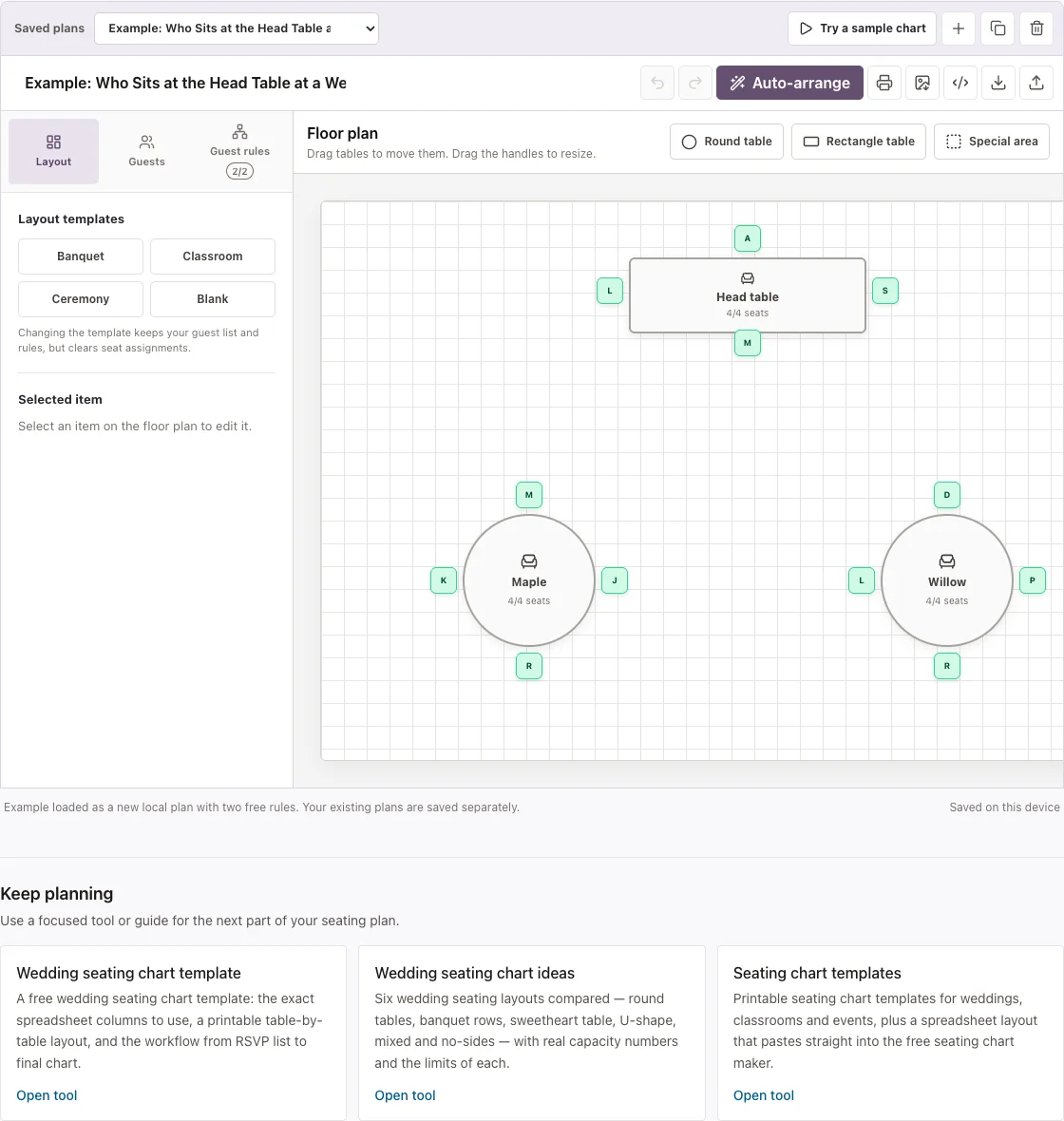
Actual tool screenshot using fictional guests. Confirm furniture, capacity and walking routes with your venue.
Open the editable head-table example
The example has two Together rules: Alex with Sam, and Maya with Leo. These rules preserve the pairs at the same table during auto-arrange. They do not require both pairs to share the head table, nor do they guarantee adjacent chairs. The initial head-table positions are manual assignments.
If those exact seats must remain, lock the selected guests in place before arranging the rest. If you instead want all four people kept at the same table by relationship rules, linking the two pairs needs an additional rule. The free allowance is two rules in total; unlimited rules require an Event Pass for that event. You can keep using manual placement without adding that third rule.
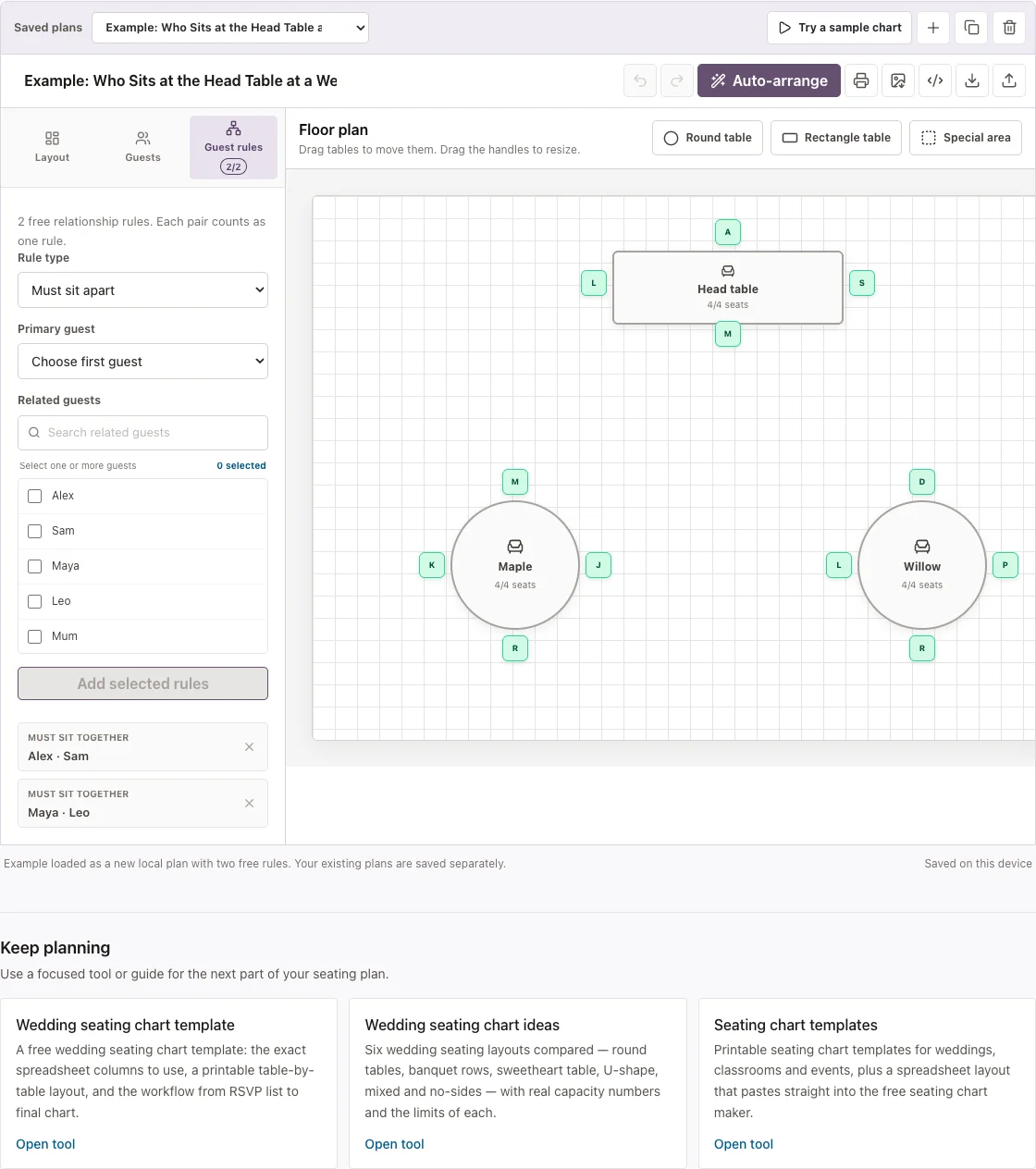
Together means the same table. Review the final table and chair assignments after rearranging.
This distinction prevents a common planning misunderstanding: entering a relationship is not the same as reserving a particular location. The software handles the constraints you specify; you still decide which arrangement feels appropriate for your guests.
A practical order for making the final chart
- Confirm the working headcount. Start with accepted invitations and identify outstanding answers. Keep one guest list instead of reconciling several competing versions.
- Check the room and capacities. Use the venue's confirmed table counts and workable seat numbers. A spare chair on a sketch is not proof that a table can accommodate another place setting.
- Choose the couple's table. Count everyone included, including attendants' partners where applicable.
- Reserve necessary positions. Agree access needs and any fixed placements before distributing flexible groups.
- Place relationships, then remaining guests. Keep partners and needed companions together. Give each person a connection rather than treating them as the last name that fits.
- Review one table at a time. Imagine the conversation and check whether anyone is isolated, unexpectedly separated or placed in an uncomfortable group.
- Confirm and distribute the final version. Use the venue's deadline, mark the version date and send matching information to the relevant staff.
For a late cancellation, first consider whether a small manual adjustment is enough. If you run auto-arrange again, review any relationships and positions that are not protected. Replace outdated exports so the coordinator and caterer do not work from different versions.
How to handle a seating objection politely
Ask what the person needs before changing the chart. “I cannot hear the speeches from there” is a practical issue; “I should have a more important table” is a different conversation. Correct genuine omissions, access problems and accidental partner separations promptly.
A calm explanation can stay brief: “We have seated you with people you know and checked the view. We need to keep this arrangement so the other groups still fit.” You do not need to circulate everyone's private preferences to justify a decision. Agree who will manage last-minute questions so the couple is not redrawing the room during dinner.
Related wedding seating guides
Frequently Asked Questions
Do the bride's and groom's parents have to sit together?
No. A shared table is an option when everyone is comfortable, but separate family tables are also workable. Include invited partners and check comparable views and access rather than using one arrangement for every family.
Should wedding-party members sit with their dates?
Keeping them at the same table is a considerate default, particularly when a date knows few people. If a head table cannot fit everyone, attendants can sit with their partners at guest tables. Discuss the arrangement before finalizing it.
Is it rude to have a singles table?
A table of unpartnered friends who know one another is not automatically a problem. Grouping strangers solely because they are single, especially with a public label or matchmaking expectation, can make guests uncomfortable. Build tables around connections and preferences instead.
Do children need their own table at a wedding?
No. Discuss seating with their caregivers, including any high-chair or supervision needs. A separate children's table should be an agreed arrangement that suits the children and the room, not a default based only on age.
Should wedding guests have assigned tables or assigned seats?
Either can work. Assigned tables give guests flexibility within a group, while assigned seats help when particular places or meal-service arrangements matter. Check what the venue and caterer require before choosing the display format.
When should I finish my wedding seating chart?
Use the final headcount and seating deadlines agreed with your venue and caterer. Prepare the groups earlier, then confirm outstanding replies and produce one dated final version. For later changes, notify the people using the plan and replace superseded copies.