Wedding seating guide
Head Table vs Sweetheart Table: Where Should Your Party Sit?
Choosing a head table vs sweetheart table comes down to who you want beside you during dinner, where their partners will sit, and what your venue can comfortably fit. A head table includes the couple and selected guests, often the wedding party. A sweetheart table seats only the couple; attendants sit at guest tables with their partners or friends. Neither choice requires you to split couples or rank your friendships.
Start with names rather than a photograph of a beautiful table. Four attendants can mean four seats, eight seats with partners, or another number entirely. Once you count everyone you want to include, the choice usually becomes easier. This guide compares the arrangements, works through a seat-count example, and shows a small layout you can edit in the wedding seating chart maker.
Head table vs sweetheart table: a quick comparison
| Decision | Head table | Sweetheart table |
|---|---|---|
| Who sits with the couple? | Selected attendants, their partners, or close family | Nobody else; it is a table for two |
| Where does the wedding party sit? | At the head table if included; otherwise at guest tables | At guest tables with partners and familiar people |
| Main advantage | You share dinner and conversation with a chosen group | You can eat together while giving other groups flexible seating |
| Main planning challenge | Including partners can substantially increase the seat count | Attendants still need thoughtful assigned places elsewhere |
| What to check with the venue | Usable seats, table configuration, access and sightlines | Position, service access and room to approach or leave |
These are reception options, not rules for the ceremony. Cultural and family expectations may differ. If your celebration has a specific top-table tradition, discuss it with the people involved before printing place cards.
Who sits at the head table at a wedding?
The couple can sit with their wedding party, a smaller group of honor attendants, or close family. The Knot's head-table seating guide describes these as common alternatives. There is no need to copy a particular lineup if it makes your guests uncomfortable or exceeds the available seating.
Write the complete invitation names into the plan. “Maid of honor” is a role; “Maya and Leo” is a seating decision. If Maya is your attendant and Leo is her invited partner, deciding whether both will join you is more useful than deciding which side a role traditionally belongs on.
A head table also does not have to place everyone in one long row facing the room. Ask your venue about a table with seating on both sides if conversation is a priority. Confirm where the couple will sit and whether those seats provide a clear view for speeches. Do not infer usable capacity from the length of a table in an inspiration photo.
Include partners before you settle the table size
Our practical recommendation is to plan invited partners together wherever possible. If the full group will not fit, change the arrangement before treating partners as overflow guests. A smaller head table or a sweetheart table can solve the problem without assigning someone a meal among strangers.
Ask about preferences privately when an attendant has unusual circumstances. Someone attending with a child may prefer a family table; another attendant may enjoy sitting with old friends and their partner. Their ceremony role does not have to determine their dinner neighbors.
Where does the wedding party sit with a sweetheart table?
Give each attendant an assigned guest table with their partner and people they are comfortable talking to. You can put several attendants together, split them between two nearby tables, or seat them with separate friendship groups. They do not all need to share one table simply because they stood beside you during the ceremony.
For example, two attendants and their partners who know each other could share a table with mutual friends. Another attendant might join siblings and their partner at a family table. Both arrangements can work within the same reception. Check that nobody is left as the only unfamiliar person because everyone else was grouped by wedding role.
Place speakers where they can reach the microphone without squeezing behind occupied chairs. “Near the couple” is useful only if that location also works for the guests: a table beside a loudspeaker or a busy service door is not automatically a good seat.
A sweetheart table gives you the option of sharing a meal for two, but it does not guarantee privacy. Guests may approach you throughout dinner. Coordinate with your planner or venue if you want time to eat before circulating, and leave a clear route to the guest tables.
Count seats before choosing your layout
Consider this fictional group: Alex and Sam are the couple. They have six attendants, and four of those attendants are bringing partners. If everyone joins the couple, the table needs twelve places, not eight.
| People included | Seats |
|---|---|
| Alex and Sam | 2 |
| Six attendants | 6 |
| Four invited partners | 4 |
| Total at a shared head table | 12 |
Suppose the venue confirms only ten usable seats in your preferred head-table position. You now have a concrete decision. You could use a different table configuration approved by the venue, choose a smaller group to join you, or put the couple at a sweetheart table and arrange ten guest seats for the attendants and partners.
Do not solve the mismatch by assuming two extra chairs will fit. Place settings, chair width, table legs, floral arrangements and service needs all affect usable space. Ask the venue to approve the actual layout rather than relying on a generic capacity chart.
If you choose the sweetheart option, the ten other people do not automatically fit into two equal social groups. List the pairs and existing friendships first. Then assign tables with appropriate spare seats for other friends. An odd number at a table is less of a problem than a comfortable pair being separated for visual symmetry.
A small head-table example you can edit
The example below uses twelve fictional guests. Alex and Sam sit at a four-seat head table with Maya and Leo. Two separate four-seat tables, Maple and Willow, hold the other guests. This is a compact demonstration, not a claim that a four-seat head table is right for every wedding.
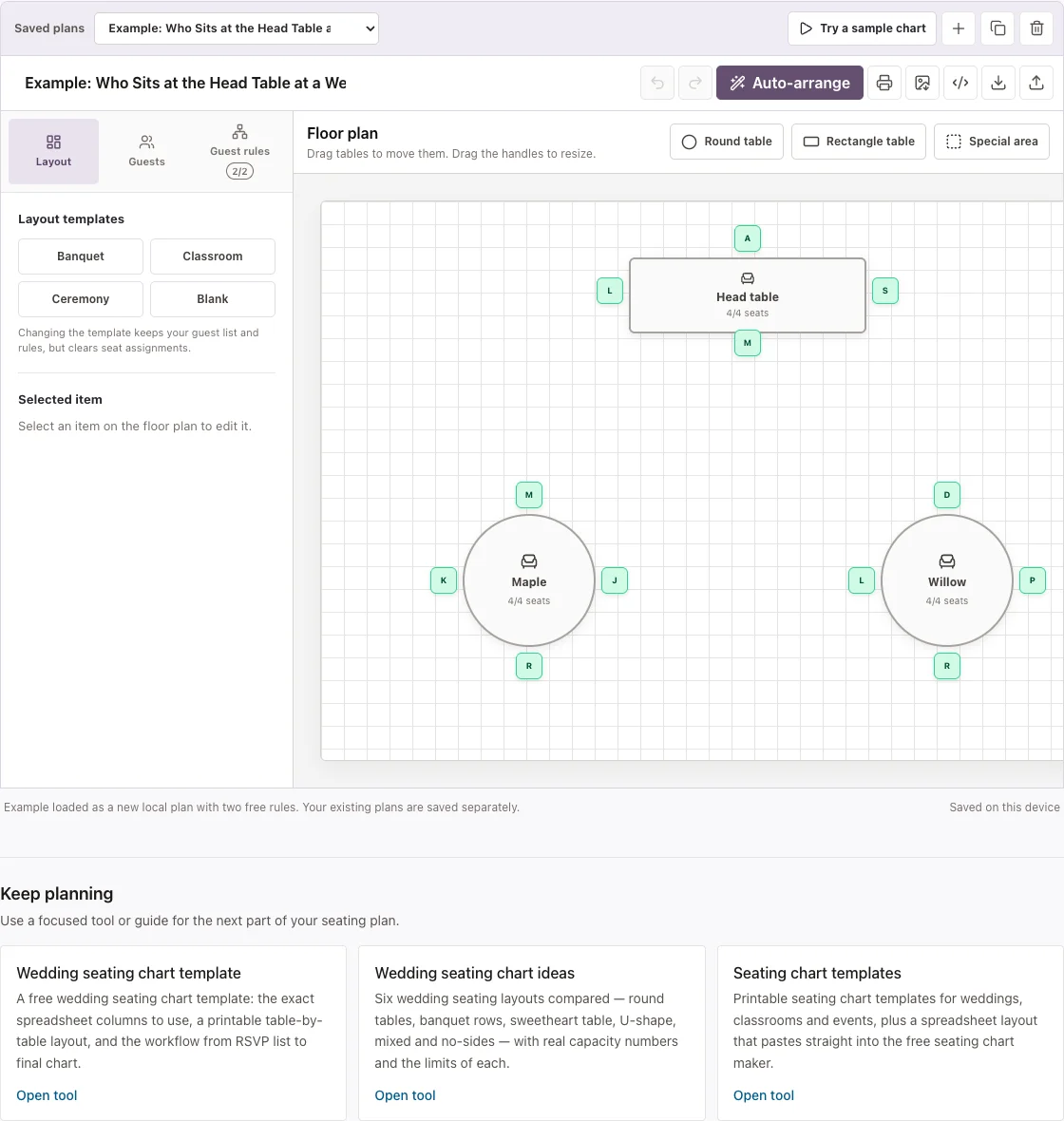
The screenshot is reused from our etiquette guide because it shows this same editable example. It illustrates the planner interface and table assignments; it is not a measured venue floor plan. Your venue still needs to approve dimensions and circulation space.
Open the editable head-table example
To compare it with a sweetheart arrangement, first save a backup of your starting plan. Keep Alex and Sam together, move Maya and Leo to an appropriate guest table, and reduce the couple's table to two seats. If neither existing guest table has two spare places, increase capacity only if the real table supports it, or add a suitable table and rebalance the guest groups.
Compare the two versions using the same guest list. Count every guest once, check every table's capacity, and decide which version makes dinner easier for the people involved. Changing the table label alone does not change its capacity or move any guests.
What Together rules can and cannot do
The sample has two Together rules: Alex with Sam, and Maya with Leo. They express that each pair should share a table during auto-arrange. They do not require both pairs to share the same table, reserve a named head table, or guarantee neighboring chairs.
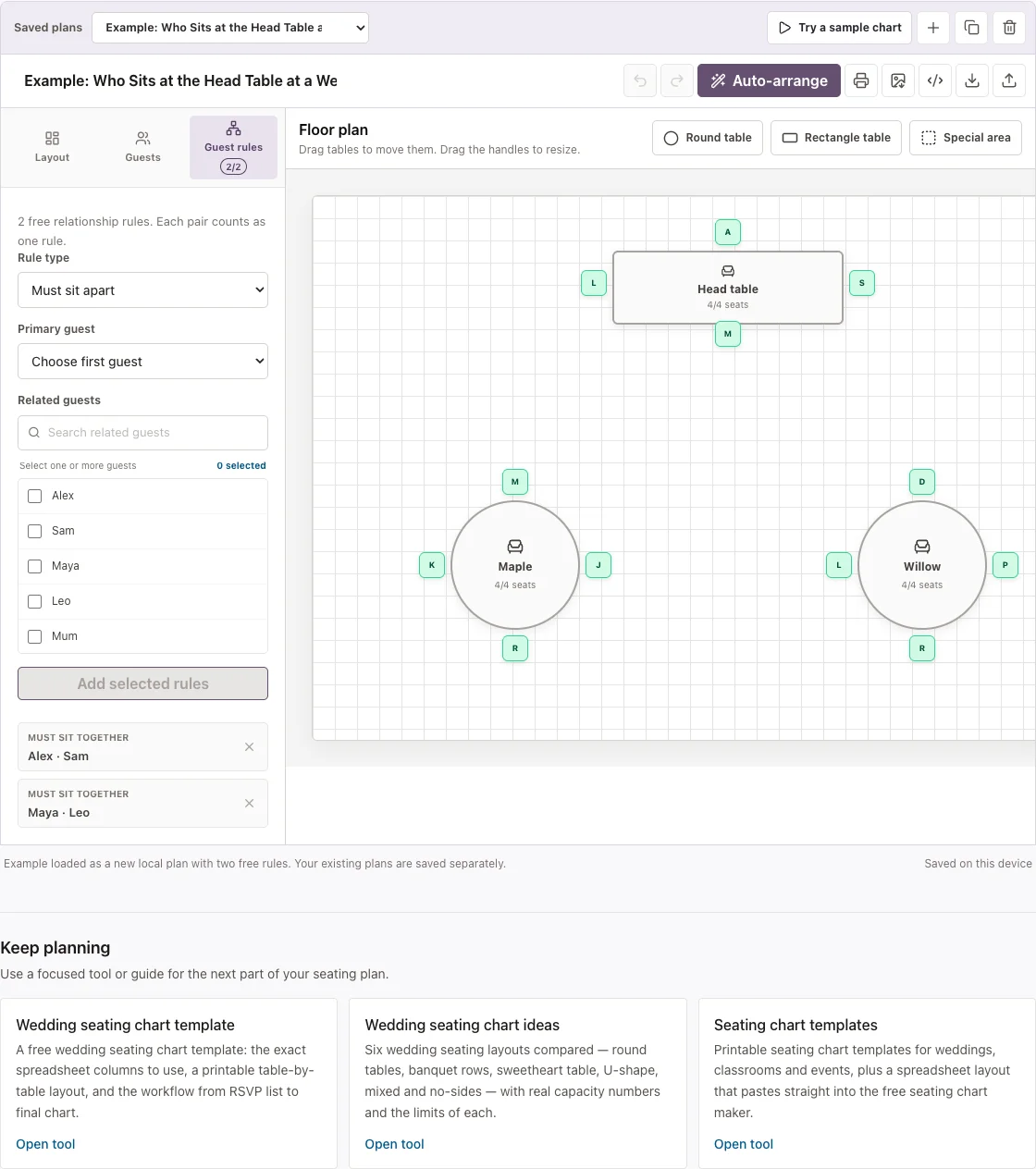
The head-table assignments shown above are manual. Review the final seat positions after making changes; a relationship preference is not a substitute for checking the layout. If you use seat locks to preserve chosen positions before arranging the remaining guests, also check that the locks and relationship rules are compatible.
Together/Apart rules require a $9.90 Event Pass for one event, with unlimited rules. The example layout can be edited free, but configuring or applying these relationship rules requires the pass. Manual seating, auto-arrange without relationship rules and printing are free. Start with the actual seating problem rather than adding rules to every possible pair.
What about parents and a family head table?
A family table is another option if you would rather eat with parents or other close relatives. Count their partners and any other people you intend to include before naming it the “parents' table.” Families differ, and that label can conceal several decisions.
If a shared family table would create tension or uncomfortable exclusions, give each group a considered place elsewhere. A sweetheart table can simplify the couple's seats, but the family arrangements still need attention. Our guide to seating divorced parents at a wedding covers separate family tables and how to communicate the plan.
Explain the practical choice without presenting it as a ranking: “We are sitting together for dinner, and you will be with Jo, Rose and Kim at Maple.” Specific names give guests more reassurance than a vague promise that everyone has a good table.
Check these details before printing the seating chart
- Confirm the people. Include each attendant's invited partner and any relevant family seating needs. Check late RSVP changes against the actual names.
- Confirm capacity. Ask the venue to approve the table arrangement with occupied chairs and service space, not just empty furniture.
- Check access. Look at routes to entrances, restrooms and the dance floor. Ask guests about access needs instead of making assumptions.
- Check views and sound. Review speakers, the microphone position, tall decorations and any obstruction between guests and speeches.
- Check the meal plan. Match named seats to meal selections if your caterer requires that detail. Clarify whether guests choose seats within an assigned table.
- Share the final version. Give the venue or coordinator one agreed seating plan. Keep private relationship notes out of the guest-facing chart.
For the rest of the reception, use our wedding seating chart etiquette guide. It covers parents, children and other guest groups so the couple's table fits into a complete plan.
Related wedding planning guides
The screenshots above illustrate the seating layout and rule concepts; any older free-rule counter shown does not describe the current plan. Together/Apart rules now require an Event Pass.
Frequently Asked Questions
Does the wedding party have to sit at the head table?
No. You can seat attendants at guest tables with their partners, friends or family. Give them assigned places and consider any practical needs for speeches rather than assuming their ceremony role dictates where they eat.
Do partners sit at the wedding head table?
They can, and including them is a useful starting point when counting seats. If the expanded group will not fit, consider a smaller head table or a sweetheart table with attendants and partners seated together elsewhere.
Is a sweetheart table rude to the wedding party?
A table for the couple does not by itself exclude or disrespect the wedding party. What matters is providing comfortable seating for attendants and their invited partners, and explaining the arrangement clearly when needed.
Who sits next to the couple at a head table?
Choose the people you want beside you during dinner, which might be honor attendants, their partners or close family. There is no single lineup that fits every celebration; check any cultural expectations and the actual chair arrangement before assigning names.
How many people fit at a head table?
The answer depends on the tables, chair placement and venue requirements. Count the couple, all included attendants and their partners, then ask the venue to confirm usable capacity for that exact arrangement.
Does a Together rule reserve seats at the head table?
No. In EasySeatingChart, Together means guests should share a table, not a particular named table or adjacent chairs. Set and review the intended seats separately, especially after using auto-arrange.