Wedding seating guide
Seating Chart for 100 Guests: Two Layouts and a Table-by-Table Plan
For 100 people, ten tables seating ten provide exactly 100 seats. Tables seating eight require thirteen tables, giving you 104 seats. Both calculations work, but neither tells you whether the people you want together will fit. A group of nine fits at a ten-seat table and needs a different arrangement at eight-seat tables.
Before assigning anyone, decide whether “100 guests” includes the couple. In this worked example, it means 100 people eating in the guest seating area, including the couple. The groupings below are illustrative. Use the example as a starting point in the wedding seating chart maker, then replace the groups with your own confirmed list.
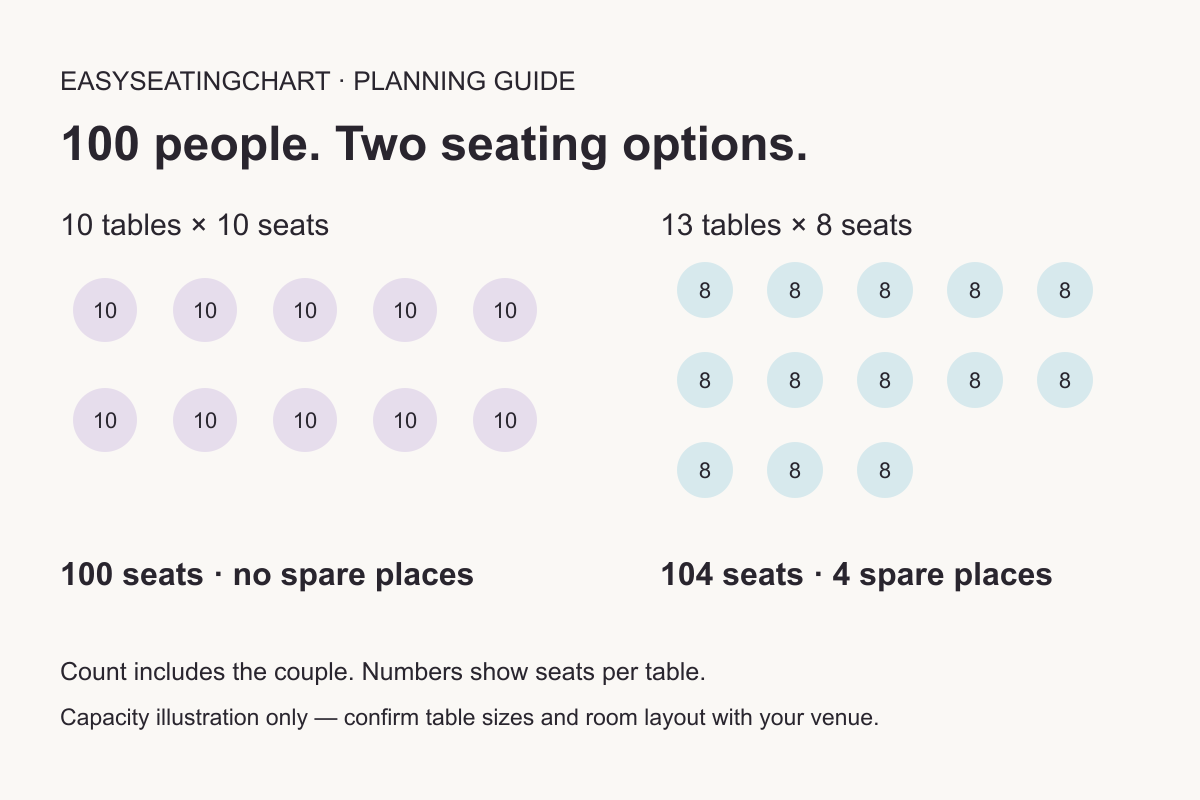
Choose a capacity before choosing seats
Ask your venue which table configurations it can accommodate with your actual chairs, place settings and service arrangement. A table's advertised capacity is not a promise that the same number will be comfortable in your room. These are seat-count scenarios, not a scaled venue floor plan.
| Arrangement | Available seats | Spare seats | What to resolve |
|---|---|---|---|
| 10 tables × 10 people | 100 | 0 | Every table must be full; one extra diner requires a change |
| 13 tables × 8 people | 104 | 4 | More tables must fit the venue; groups larger than eight need dividing |
| Sweetheart table for 2 + 10 tables × 10 | 102 | 2 | The remaining 98 people need guest-table assignments |
Four spare seats do not necessarily mean space for a family of four. If they are scattered across four tables, keeping that family together still requires moving other people. Track usable group space as well as total capacity.
If your 100 guests exclude you and your partner, plan for 102 people instead. Ten ten-seat tables alone will not cover that count. List vendor meals separately and agree with the venue where those meals will be served.
Build a guest list that can actually be seated
Give every person a separate entry, including children who need a place. Keep household and partner information alongside the names. A placeholder such as “Taylor's partner” is easier to reconcile than an invisible extra seat; replace it when the name is confirmed.
Mark the few constraints that would make an arrangement unworkable: partners who should remain together, a child who needs to sit with a caregiver, or relatives who should be at different tables. Ask about access needs privately rather than guessing from someone's age. Confirm any necessary physical space with the venue.
For decisions about partners, children and table etiquette, see our wedding seating chart etiquette guide.
Do not make every friendship a fixed rule. Start with essential groupings, then use familiar faces to improve the remaining tables. If every preferred connection becomes mandatory, a simple 100-person list can become impossible to fit.
A worked plan: ten tables of ten
Here is one possible allocation. It shows the arithmetic, not a universal order of family importance. “Household” includes everyone counted in that group.
| Table | People assigned | Count |
|---|---|---|
| 1 | Couple (2), two attendants and their partners (4), two close-friend couples (4) | 10 |
| 2 | Family A household (4), family A household (3), three relatives (3) | 10 |
| 3 | Family B household (4), family B household (4), one relative couple (2) | 10 |
| 4 | Four relative couples (8), two adult cousins (2) | 10 |
| 5 | Two households with children (5 each) | 10 |
| 6 | Three friend couples (6), four mutual friends (4) | 10 |
| 7 | Two friend couples (4), six mutual friends (6) | 10 |
| 8 | Four colleague couples (8), two colleagues who know the group (2) | 10 |
| 9 | Extended-family household (6), extended-family household (4) | 10 |
| 10 | Three neighbour couples (6), four family friends (4) | 10 |
| Total | Each person appears once | 100 |
Build the least flexible tables first. In this example, Table 5 contains two intact households of five. Moving one household creates a five-seat problem elsewhere, so it is a poor place to start making casual changes.
Table 1 is a shared dinner table rather than a requirement to seat every attendant together. If you want a separate couple's table, compare the options in our head table vs sweetheart table guide before moving those two people out.
What changes with eight-seat tables?
Do not shrink the ten-table plan by removing two people from every table. Rebuild the groups around the new capacity. A household of five can share with three other people, but two such households cannot share an eight-seat table.
One valid distribution is nine tables of eight and four tables of seven: 72 + 28 = 100. That leaves one empty place at each seven-person table. Another is twelve tables of eight and one table of four, but the smaller table deserves a deliberate social grouping rather than becoming a collection of leftovers.
Neither distribution is automatically better. Choose the one that preserves relationships and fits the room. For family tensions, use the arrangements in our divorced-parents seating guide rather than forcing everyone onto one family table.
Check the plan before you print it
First, compare the assigned count with the confirmed dining list: 100 people should produce 100 assignments, with no duplicates and nobody unseated. Then check each table against its agreed capacity.
Next, read every table as a conversation group. Does each person have someone familiar nearby? Have partners or caregivers been separated accidentally? Does a proposed change solve one problem while creating another?
Finally, review the layout with the venue. Table numbers alone do not show accessible routes, service space or proximity to speakers. Keep dietary and private relationship notes out of the guest-facing display. Give staff the information they need through a separate agreed document.
Save a dated final version. If two people cancel, remove their assignments before moving anyone else; two empty seats may be preferable to rebuilding several comfortable tables.
Frequently Asked Questions
How many tables do I need for 100 guests?
Ten tables at ten seats or thirteen tables at eight seats cover 100 people. Confirm that your count includes everyone needing a guest-table place and that the venue approves the configuration.
Does the couple count in the 100?
In this example, yes. If your list contains 100 invited guests plus the couple, you need 102 places instead. Write that distinction at the top of your working list.
Can twelve tables of eight seat 100 people?
No. Twelve tables of eight provide 96 seats, leaving four people without a place. Add a thirteenth table or ask the venue to approve a different mix of table sizes.
How do I divide 100 people among thirteen tables?
One option is nine tables of eight and four tables of seven. This seats all 100 people and leaves four spare places. Check household sizes before deciding where those empty places belong.
What if a family is larger than one table?
Split it into smaller, comfortable groups, keeping dependants with caregivers. Nearby tables may work well, but confirm actual positions rather than assuming consecutive table numbers mean adjacent tables.
Can I leave seats empty?
Yes, if the venue's arrangement allows it. Empty seats can give you flexibility. They only help accommodate a new group together when enough usable places exist at the same table.
Try the free wedding seating chart maker to enter your list, create tables and check the assignments. Start with the real headcount; refine the room layout with your venue before printing.